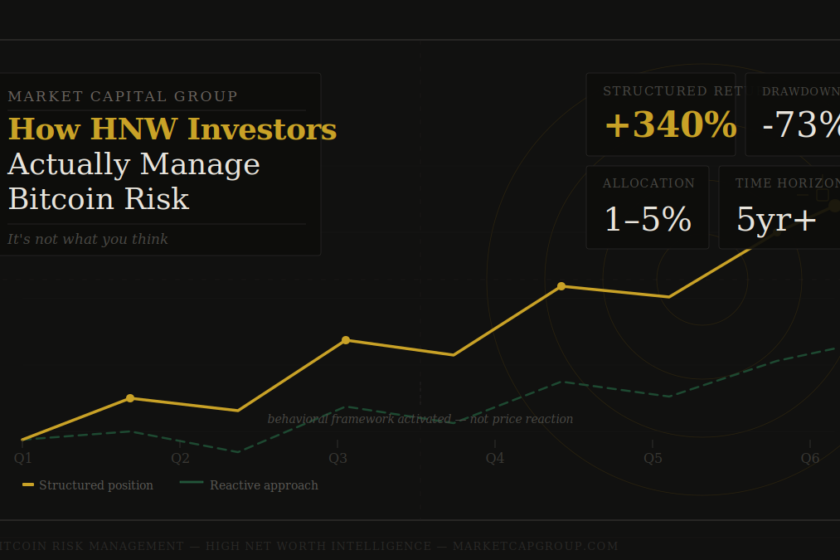
Most people think managing Bitcoin risk means watching price charts. Refreshing CoinMarketCap at midnight. Setting stop-losses. Panic-selling when the news turns bad.
That’s not risk management. That’s anxiety dressed up as strategy.
The investors who have built and preserved serious wealth through Bitcoin — the family offices, the high net worth individuals who’ve held through multiple 70–80% drawdowns and compounded out the other side — manage risk in a way that would surprise most people.
They’re not glued to screens. They’re not reacting to every macro headline. And they’re not trying to time the market.
What they’re doing is something quieter, more structural, and far more effective. This article breaks down exactly how they do it — and what it means for you.
Before you can manage Bitcoin risk, you need to define it correctly. Most investors define it wrong.
Common mistake: “Bitcoin risk = price going down.”
What sophisticated investors know: Bitcoin risk is multi-dimensional. It includes:
A $10 million portfolio with 3% in Bitcoin faces very different risks than the same portfolio with 35% in Bitcoin. The asset doesn’t change. The risk profile does — dramatically.
High net worth investors begin by mapping all of these risks. Most retail investors only see one.
At Market Capital Group, our entire framework is built around identifying which of these risks is most acute for a given investor — before recommending any positioning strategy.
The single most important mental model that separates institutional Bitcoin investors from everyone else is this:
The goal is not to outperform Bitcoin. The goal is to survive it — and compound through it.
This sounds obvious. It isn’t. When Bitcoin is rising 200% in a bull cycle, the pressure to be “fully in” is intense. When it’s falling 60%, the pressure to exit entirely is equally intense. Both of these impulses are enemies of long-term wealth.
Sophisticated investors build a framework before the emotion arrives — so the framework makes decisions, not the feelings.
Here’s what that framework typically looks like.
Wealthy investors don’t size their Bitcoin position based on how they feel about the market. They determine an allocation target based on:
A commonly referenced range for high net worth portfolios is 1–5% in Bitcoin as a base allocation, scaling up depending on conviction and risk tolerance. Some family offices go higher — 10–15% — but with deliberate risk controls in place.
The key point: the allocation is set in advance. Not adjusted after every piece of macro news.
Our Portfolio Allocation Strategy service helps investors determine appropriate Bitcoin allocation within their total portfolio — based on risk tolerance, capital profile, and time horizon, not market sentiment.
One of the most destructive behaviors in Bitcoin investing is making exit decisions reactively — when prices are already crashing and emotions are high. By that point, rational thinking has largely left the room.
HNW investors define their exit conditions in advance:
This isn’t about predicting the market. It’s about removing the decision from the moment of maximum stress.
Think of it like a pre-written flight plan. Pilots don’t decide how to respond to turbulence while the plane is shaking. They follow protocols built before takeoff.
Many sophisticated Bitcoin investors split their position into two buckets:
Core position: Long-term wealth allocation. Not touched regardless of price action. Held in cold storage. Sized so that even a complete loss would not be catastrophic.
Tactical position: A smaller portion used to express views on market cycles — potentially increased near what looks like cycle bottoms, reduced near what looks like cycle tops. This portion has defined rules for how it’s managed.
This structure gives investors the psychological stability to hold through volatility while still having an active, disciplined approach to market cycles.
Here’s where sophisticated Bitcoin investors diverge most sharply from typical retail behavior: they’re not watching price as their primary signal.
Price is a lagging indicator of what’s already happened. Experienced investors watch leading and structural indicators:
Bitcoin is deeply correlated to global liquidity. When central banks are expanding balance sheets and credit is cheap, risk assets — including Bitcoin — tend to rise. When liquidity tightens, they fall.
Smart investors track: Fed balance sheet trends, M2 money supply, DXY (US Dollar Index), and global central bank policy direction. These signals often move before Bitcoin’s price does.
Bitcoin’s blockchain is fully transparent. You can see, in real time, how much Bitcoin is sitting on exchanges (a potential sell signal), how much is being moved off exchanges into cold storage (a holding signal), what long-term holders are doing with their positions, and what the market looks like at a miner-cost-basis level.
These signals don’t predict price with certainty — nothing does. But they provide structural context that price charts alone cannot.
This is the foundation of our Market Cycle Intelligence service — ongoing research into liquidity conditions, institutional flows, and cycle positioning for serious allocators.
Tools like MVRV Z-Score, the Puell Multiple, and realized price ratios give investors a rough sense of where Bitcoin sits in its historical market cycle. Are we in an early accumulation phase? A late-cycle euphoria? A capitulation bottom?
None of these are crystal balls. But they help investors make decisions based on structural market conditions rather than short-term noise.
Perhaps the most overlooked risk management tool is also the simplest: a long enough time horizon.
Bitcoin has had six drawdowns of 70% or more in its history. Every single time, it recovered and reached new all-time highs — for investors who held through the drawdown without being forced to sell.
“Forced to sell” is the operative phrase. High net worth investors engineer their financial lives so that they are never forced to sell Bitcoin at a bad time. They do this by:
When you’re not forced to sell, volatility becomes a feature rather than a bug. Drawdowns become potential accumulation opportunities rather than emergencies.
Our Drawdown Protection Framework is specifically designed to help investors reduce exposure during high-risk periods and preserve capital through downturns — without emotional decision-making.
Sophisticated investors take custody risk as seriously as market risk — often more so. Because a market can recover. Lost Bitcoin cannot be recovered.
The institutional approach to custody typically includes:
This isn’t paranoia. It’s appropriate diligence for a bearer asset. Bitcoin ownership is proof-of-key. Whoever controls the keys controls the Bitcoin.
It’s worth noting: Market Capital Group operates as a non-custodial advisor. We never hold or control client Bitcoin — our role is to provide the strategic framework while clients retain full custody of their assets.
Understanding what HNW investors avoid is just as important as understanding what they do:
They don’t trade their core position. The behavioral cost of active trading — buying high in excitement, selling low in fear — almost always outweighs whatever market timing benefit is theoretically possible.
They don’t use leverage. Leverage introduces liquidation risk: the possibility of being forced to sell at exactly the wrong time. In an asset as volatile as Bitcoin, leverage is how wealth gets destroyed, not built.
They don’t follow retail sentiment. Twitter, Reddit, mainstream financial media — these are lagging sentiment indicators, not useful signals. By the time something is on the front page, the price has already moved.
They don’t need Bitcoin to perform on a specific timeline. Wealthy investors have the patience that comes from financial security elsewhere. They’re not counting on Bitcoin to fund next year’s expenses.
They don’t ignore tax implications. Every sale is a taxable event. Sophisticated investors work with tax advisors to structure their Bitcoin activity in a way that minimizes drag and preserves compounding.
If there is one thing that separates investors who build lasting wealth through Bitcoin from those who don’t, it is not intelligence, information, or even timing. It is behavioral discipline.
The ability to hold through a 70% drawdown without selling. To not buy at the top because FOMO got overwhelming. To have a written framework and actually follow it.
This is genuinely hard. It’s hard for retail investors, and it’s hard for professionals. The difference is that institutions build structures and processes that make the right behavior the default. They remove as much discretion as possible from high-emotion moments.
That’s the real insight. Bitcoin risk management is not primarily a market analysis problem. It is primarily a behavioral architecture problem.
If you’re a high net worth investor trying to apply these principles, start here:
High net worth investors don’t manage Bitcoin risk by being smarter about price. They manage it by being more structured about behavior, more deliberate about sizing, more patient about time, and more rigorous about custody.
The investors who lose money in Bitcoin — even during bull markets — typically fail not because they picked the wrong asset, but because they were structurally exposed to volatility they couldn’t psychologically or financially withstand.
Get the structure right. Everything else follows.
If you’d like to see how these principles apply to your specific situation, the next step is a consultation with our team.
Request a Consultation — Market Capital Group →
We work exclusively with high net worth individuals and family offices holding $200,000+ in Bitcoin who are serious about managing it like an asset class, not a speculation.
Market Capital Group provides non-custodial Bitcoin risk management and advisory services for high net worth investors. This article is for informational purposes only and does not constitute financial advice. Learn more about our services →